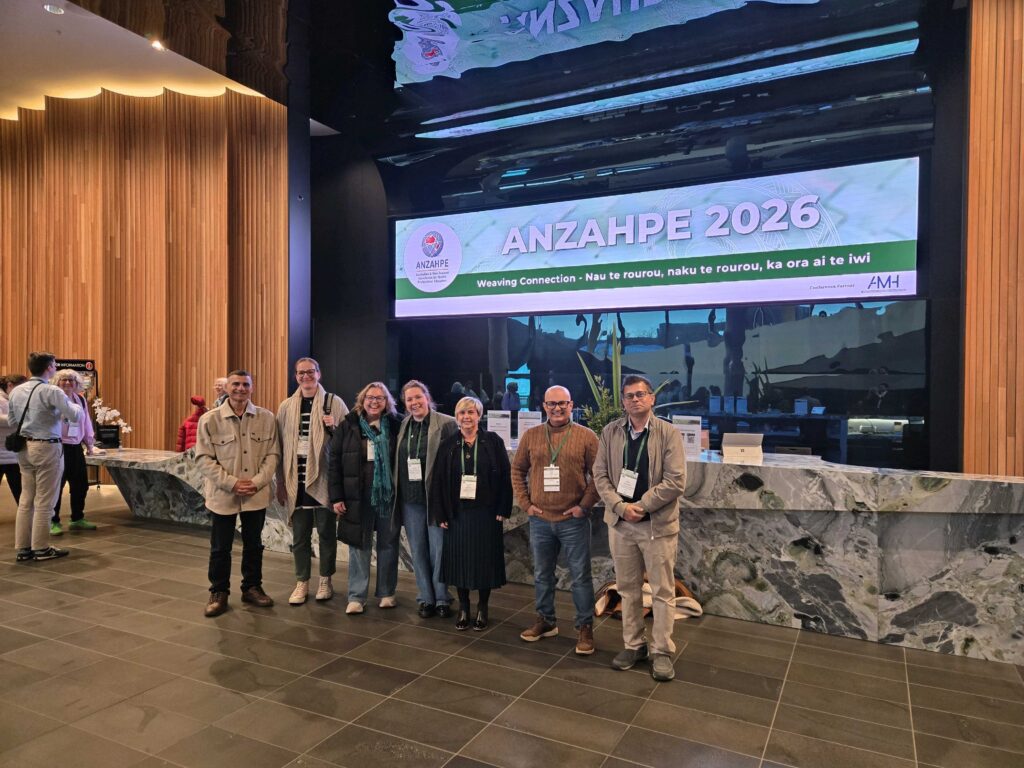
The Federation University NewMed School of Medicine team recently returned from an inspiring and immersive experience at the Australian & New Zealand Association for Health Professional Educators (ANZAHPE) conference. Enriched by the deep wisdom of Māori and First Nations leaders, the gathering provided a powerful opportunity to strengthen collegiate connections while gaining profound insights into cultural safety, community partnership, and the future of medical education.
Listening to Lived Experience and Community Voice
A major highlight of the conference was the opening plenary panel on weaving community connections, led by Professor Suzanne Pitama, Dr Tracy Haitana, Dr Huhana Hickey, and Dr Kelly Tikao. The presenters challenged health education institutions to see, listen, teach, and act differently—emphasising that lived experience must serve as primary data rather than a secondary consideration in medical training.
Further inspiration came from Professor Sonia Kumar of St Mary’s University, London, who detailed how genuinely involving the community in medical school design fundamentally shifts educational priorities. When asked what characteristics they desired in a doctor, community members prioritised:
Humility and Curiosity
Trust and Dignity
A sense of Belonging
These insights challenge medical educators to move beyond purely technical competencies and build training models that produce the compassionate, relationally skilled clinicians that communities actually need.
Showcasing Pedagogical Innovations
Throughout the conference, Medical School faculty contributed significantly to the academic dialogue, presenting our innovative curriculum frameworks, assessment models, and approaches to student wellbeing:
First Nations and Generalist Knowledge: Dr Narawi Foley Boscott and Associate Professor Johanna Lynch presented the Kalim Warambalam Knowledge Tree and Clinical Framework, offering key insights into building medical education aligned with Australian Medical Council (AMC) standards through generalist practice and First Nations ways of knowing.
Whole Person Student Wellbeing: Associate Professor Sue Hawken presented Weaving Connection and Shared Wellbeing Through a New Medical Program, highlighting Whole Person approaches, longitudinal relationships, relational learning support, and comprehensive student care embedded within an innovative curriculum.
Advocacy and Public Health: Associate Professor Kazi Rahman outlined the MD Program Advocacy and Public Health framework, which is embedded across the entire MD program through integrated delivery pathways
Feedback-Centric Evaluation: Associate Professor Iulia Oancea presented Using Keywords to Weave a Longitudinal Narrative Across Assessments and Feedback Over Scoring in Programmatic Assessment for Learning. She emphasised how programmatic assessment serves as a central, feedback-driven model that supports continuous student growth rather than single-point testing.
Context Engineering: Associate Professor Mohit Shahi delivered two presentations: Scaffold Success: Weaving Connections in the NewMed Curriculum and From Prompt to Purpose: Context Engineering for AI-Assisted CBL Case Creation.
Responsible Generative AI Framework: Professor Hayder Al-Aubaidy presented the Development of a Responsible GenAI Use Framework for Education and Research in the NewMed MD Project, outlining our governance structure for human-AI partnerships in medical education.
Bringing Evidence-Based Insights Home
The conference also reinforced the growing role of artificial intelligence in clinical reasoning and validated the immense value of longitudinal integrated clerkships—a core pillar of the Medical Schools community-situated model.
Our team returns from ANZAHPE with renewed energy and focus, excited to integrate these evidence-based practices into a responsive, socially accountable medical program that puts community at the heart of care.